
Last Updated on October 31, 2026 by Dorene Lambert
Editorial & Clinical Note: The biomechanical cues, rehabilitation protocols, and recovery timelines in this guide are provided strictly for educational purposes. They do not replace formal clinical assessment, compartment pressure testing, or radiological evaluation from a licensed orthopedic surgeon or sports physical therapist.
Experiencing persistent shin splints from walking can disrupt what should be one of the most accessible low-impact forms of cardiovascular exercise. Whether you have increased your daily step count, added incline treadmill walking to your routine, or started walking on hard asphalt sidewalks, sharp or aching pain radiating down the front or inner borders of your lower legs signals that your muscular and skeletal tissues are absorbing more stress than they can remodel.
The medical term for this condition is Medial Tibial Stress Syndrome (MTSS). It represents a continuum of bone strain and fascial micro-trauma along the tibia. While runners are often considered the primary sufferers of lower-leg stress, power walkers and daily commuters frequently battle the condition when unsupportive footwear, sudden training spikes, or poor gait kinematics overload the anterior and deep posterior leg compartments. By addressing root kinematic faults, performing targeted soft-tissue releases, and using smart cross-training protocols, recovering from shin splints from walking can become a manageable and predictable process.
What Are Shin Splints? (Anterior vs. Posterior MTSS)
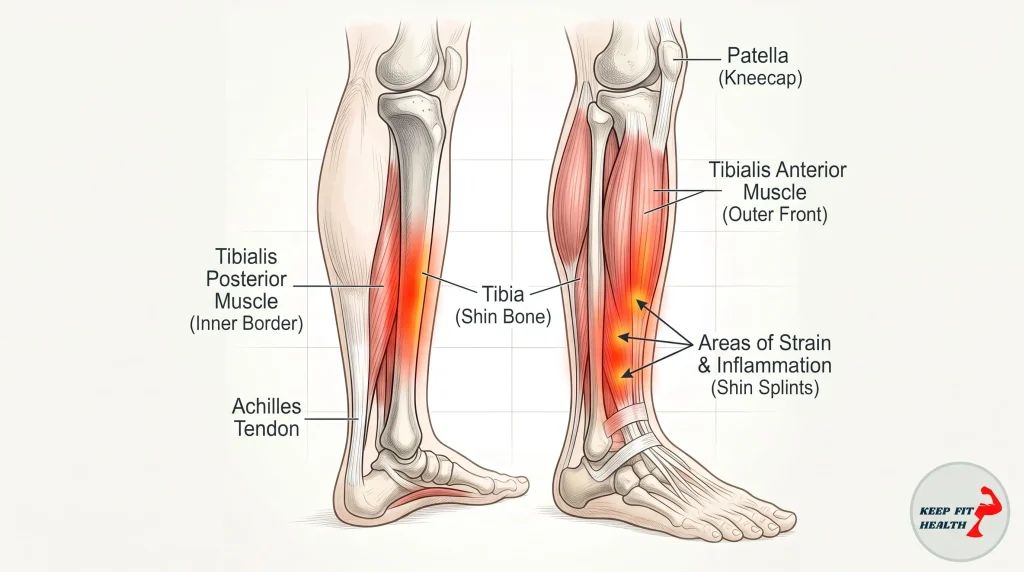
Shin splints are not a single isolated injury; they are an overuse spectrum affecting the muscles, tendons, and periosteum (the fibrous connective tissue sheath covering bone) of the lower leg.
1. Anterior Shin Splints (Front of the Shin)
- Affected Muscle: Tibialis anterior.
- Location: The front, lateral edge of the shinbone.
- Mechanism: The tibialis anterior is responsible for dorsiflexing the foot (lifting your toes) and controlling how rapidly your foot lowers to the ground after heel strike. Walking at brisk tempos or on inclines forces this muscle to perform intense eccentric contractions, resulting in localized inflammation and cramping along the front of the shin.
2. Posterior Shin Splints (Inside of the Shin)
- Affected Muscles: Tibialis posterior, soleus, and flexor digitorum longus.
- Location: The lower inner third of the shin along the medial tibial border.
- Mechanism: The tibialis posterior decelerates pronation and supports the medial longitudinal arch. When your arch collapses inward, excessive tension pulls the deep fascia away from the medial tibia, causing pain that is often confused with plantar fasciitis or Achilles strain.
Anatomical diagram of the tibia, tibialis anterior, and tibialis posterior muscles illustrating mechanical strain and periosteal pull during walking. (Visual mockup)
The Primary Triggers of Shin Splints from Walking
Understanding the root cause of your lower-leg pain prevents you from falling into the cycle of resting until the pain stops, only to trigger a flare-up during your very next walk.
1. The “Too Much, Too Soon” Training Error
Bone tissue and fascial networks remodel far more slowly than cardiorespiratory fitness improves. If your cardiovascular endurance allows you to jump from 4,000 to 12,000 steps per day, your heart and lungs will adapt within days. However, your cortical bone and connective fascial attachments require weeks of progressive mechanical loading to thicken and adapt. Sudden increases in volume, pace, or incline create micro-damage faster than osteoblasts can synthesize new bone matrix.
2. Overstriding and Excessive Braking Forces
When walking quickly, many people try to cover more distance by throwing their front foot far ahead of their pelvis.
- This forward reach causes the foot to land at a steep angle on the heel.
- The ground reaction force drives upward through the heel and straight into the shinbone, acting like a brake on your forward momentum.
- The anterior compartment muscles must fire with high force to keep your forefoot from slapping violently down against the pavement, generating severe eccentric strain.
3. Foot Biomechanics and Overpronation
An unstable foot structure is one of the most common precursors to persistent shin pain. If you have flat arches or hypermobile subtalar joints, your foot collapses inward upon weight acceptance. This inward twisting puts high rotational stress on the lower leg, pulling the tibialis posterior and soleus muscles against the tibial periosteum. Walkers facing these alignment issues benefit from learning how to choose stability footwear in our best walking shoes for flat feet guide.
4. Walking Exclusively on Hard Surfaces
Concrete has almost zero shock compliance. Walking exclusively on concrete sidewalks or asphalt roads reflects high peak impact loads into your lower extremities. Without proper midsole cushioning to dampen these forces, the tibia and its surrounding soft tissues absorb the brunt of the kinetic impact.
Shin Splints vs. Stress Fractures vs. Exertional Compartment Syndrome
Not all lower-leg pain is simple Medial Tibial Stress Syndrome. Differentiating between basic shin splints, a tibial stress fracture, and chronic exertional compartment syndrome (CECS) is critical to avoid permanent tissue damage.
| Characteristic | Medial Tibial Stress Syndrome (Shin Splints) | Tibial Stress Fracture | Chronic Exertional Compartment Syndrome (CECS) |
| Pain Distribution | Diffuse discomfort across 5 to 10 cm along the shin border | Highly localized pinpoint pain (< 2 to 3 cm) directly on bone | Full, bursting tightness across the muscular compartment |
| Pain Behavior | Aches early in the walk, may loosen slightly, returns post-walk | Sharp, throbbing pain that steadily intensifies with every step | Tightness increases until foot feels numb or weak; clears with rest |
| Morning Pain | Mild morning stiffness that clears with brief movement | Aches constantly, even while resting or bearing light weight in bed | Typically absent at rest or during non-exercise hours |
| Single-Leg Hop Test | Mild discomfort, but generally tolerable | Severe, sharp, sharp bone pain upon impact | Discomfort driven by fullness/tightness, not sharp bone pain |
| Red Flag Symptoms | None | Focal swelling, warmth, or palpable bone tenderness | Foot drop, numbness, tingling between toes |
Warning: If pressing one finger onto your shin causes pinpoint, sharp, wincing pain, or if you cannot perform a single hop on that leg without severe pain, stop walking immediately and consult an orthopedic specialist for diagnostic imaging (such as an MRI or bone scan) to rule out a cortical stress fracture.
Active Rehabilitation Protocol for Shin Pain Relief
Passive rest may calm acute inflammation, but returning to activity without strengthening the kinetic chain will only cause symptoms to return. Use this structured physical therapy protocol to rebuild your lower-leg resilience.
Rehabilitation Sequence:
1. Soft-Tissue Decompression (Calf & Anterior Tibia)
2. Joint Mobility (Ankle Dorsiflexion)
3. Isometric & Eccentric Strengthening (Tibialis Anterior / Posterior)
4. Functional Kinetic Integration (Hips & Core)
1. Foam Rolling and Targeted Soft-Tissue Release
Never roll a dense foam roller directly over the edge of the shinbone itself. Instead:
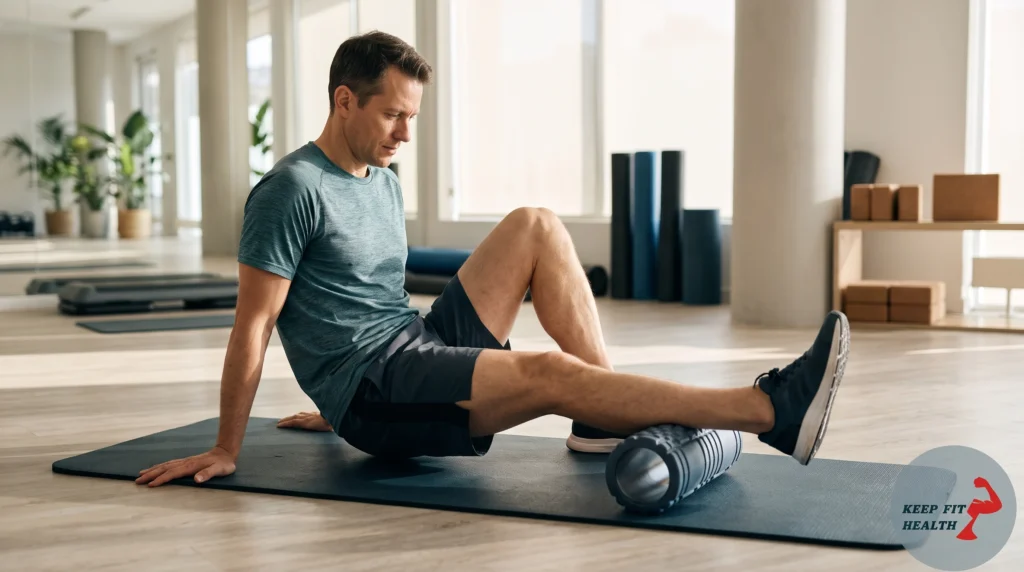
- Anterior Compartment: Kneel on a foam roller placed slightly outward on the fleshy muscle belly to the lateral side of the shinbone. Roll slowly up and down the upper two-thirds of the muscle belly for 60 seconds to reduce tonic muscle guarding.
- Calf Complex: Sit with your calf resting over a dense lacrosse ball or trigger-point roller. Cross your opposite leg over top to apply gentle downward pressure, rolling the thickest belly of the gastrocnemius and deep soleus to relieve passive tension on the ankle joint.
2. Standing and Seated Heel Walks (Tibialis Conditioning)
- How to perform: Stand tall with your shoes off on a flat, carpeted surface or yoga mat.
- Lift your forefoot and toes entirely off the ground so that you are balancing purely on your heels.
- Walk slowly forward for 20 to 30 steps while keeping your toes lifted as high as possible toward your shins.
- Rest for 30 seconds and repeat for 3 sets.
- This exercise conditions the tibialis anterior, building endurance to prevent foot-slap during brisk fitness walks.
3. Seated Resistance Band Inversion and Eversion
- Inversion (Tibialis Posterior): Anchor a light-to-medium loop resistance band to an external post. Loop the opposite end around the inside of your foot while seated. Turn your foot inward toward your midline against the band’s resistance, pause for a 2-second isometric hold, and return over 3 controlled seconds. Complete 3 sets of 15 reps.
- Eversion (Peroneal Complex): Reverse the band setup and turn your foot outward against the resistance to ensure balanced strength across the lateral stabilizers of the ankle.
4. Soleus Wall Sits
- The deep soleus muscle absorbs substantial ground reaction forces during walking.
- Lean your back flat against a wall with your knees bent at a 90-degree angle.
- While holding the wall sit position, press onto the balls of your feet to raise your heels 2 to 3 inches, hold for 3 seconds, and slowly lower.
- Perform 3 sets of 12 to 15 reps to build endurance in the deep calf tissues that shield the posterior tibia from excessive stress.
4 Biomechanical Fixes for Your Walking Form
Correcting your walking mechanics reduces ground shock and helps protect your shins on everyday routes.
1. Increase Step Cadence and Eliminate Overstriding
The most effective mechanical adjustment for shin splints from walking is to shorten your stride and step more frequently.
- Instead of reaching your heel forward, focus on rolling smoothly over your stance foot.
- Aim for a cadence of 105 to 118 steps per minute.
- Stepping at a slightly higher turnover rate ensures your foot lands directly under your center of mass, transforming a jarring braking force into smooth forward momentum.
2. Land with a Softer, Midfoot-Biased Heel Transition
Avoid slamming the posterior edge of your heel into the ground with your toes pulled up to their maximum height. Let your heel kiss the ground gently and transition weight immediately along your midfoot to the base of your toes.
3. Engage Gluteal and Core Stabilizers
Weak hip abductors (gluteus medius) allow the knee to cave inward (valgus collapse) during midstance. This dynamic misalignment forces the lower leg to overpronate to keep the foot flat on the ground.
- Consciously activate your glute muscles as you extend your leg behind you.
- Keep your pelvis level and your core gently engaged, which prevents lateral hip drop and relieves twisting forces along the tibia.
4. Vary Your Walking Surface
Avoid logging all of your miles on concrete pavement. Whenever possible, shift portions of your route to:
- Packed dirt nature trails
- Cinder or rubberized community running tracks
- Level park grass
- Shock-absorbing treadmills
The Shoe and Orthotic Matrix: What to Look For
Your footwear acts as the primary interface between ground impact forces and your skeletal system.
Ideal Footwear Criteria for Shin Pain:
├── Midsole Cushioning: Resilient EVA or Nitrogen-infused TPU to absorb shock
├── Torsional Stability: Rigid midfoot shank to prevent medial arch twisting
├── Moderate Drop: 8 mm to 10 mm heel-to-toe drop to balance load across tissues
└── Secure Heel Counter: Stiff internal cup to prevent rearfoot wobble
- Avoid Overly Flexible “Minimalist” Shoes: A shoe that you can roll into a tight ball lacks the torsional rigidity needed to stabilize an unstable arch. If the shoe twists easily under light pressure, your tibialis posterior and anterior muscles will have to work overtime to keep your foot stable.
- Replace Worn-Out Midsoles Promptly: Walking shoes should generally be retired every 350 to 500 miles. Even if the rubber outsole tread looks relatively intact, internal foam midsoles lose their elastic rebound over time, transmitting shock straight into your lower legs.
- Consider Over-the-Counter Supportive Insoles: If you have low or collapsing arches, an over-the-counter firm orthotic insert can provide immediate structural arch support, reducing the eccentric strain placed on the medial tibia.
Systemic Recovery, Nutrition, and Bone Density
Healing bone and fascial attachments requires internal metabolic support alongside physical rehab.
1. Optimize Bone Matrix Micronutrients
Cortical bone remodeling relies on adequate daily calcium, vitamin D3, and vitamin K2 intake. If dietary restrictions make meeting these baseline needs difficult, selecting a comprehensive, third-party verified formula can help prevent nutritional gaps. Review our detailed guide on the best women’s multivitamins to learn how to choose bioavailable, independent-tested nutrient formulations.
2. Collagen and Connective Tissue Support
The periosteum and fascial sheaths are built from dense Type I collagen fibers. Ensuring adequate daily protein intake (1.2 to 1.6 grams per kilogram of body weight for active adults), paired with vitamin C-rich foods, supports collagen synthesis during the active recovery phase.
3. Active Cross-Training Options
You do not need to abandon cardiovascular fitness while waiting for shin pain to resolve. Maintain aerobic fitness using zero-impact cross-training modalities:
- Indoor Cycling: Spin at moderate cadence (80 to 90 RPM) with low-to-moderate resistance. Ensure the balls of your feet are centered on the pedals without pointing your toes downward.
- Lap Swimming or Water Aerobics: Water provides buoyancy that eliminates ground impact forces while promoting circulation to the lower extremities.
- Rowing Ergometers: Provides low-impact conditioning while strengthening the posterior chain and upper back.
Frequently Asked Questions
Can I keep walking if I have shin splints?
Yes, but only within a pain-free or very low discomfort threshold (0 to 3 on a 10-point scale). If your shin pain causes you to limp, alters your stride mechanics, or hurts intensely the following morning, you are overloading the tissue and must reduce your volume. Shorten your distance, decrease your pace, switch to softer surfaces, and focus on rehabilitation exercises.
How long does it take for shin splints to heal?
Mild cases of Medial Tibial Stress Syndrome typically resolve within 3 to 6 weeks of modified activity, proper footwear, and consistent strengthening. Severe cases involving deep periosteal inflammation can take 8 to 12 weeks. Trying to return to your previous walking volume before completing rehabilitation often resets the healing timeline.
Does compression wear help relieve shin splints?
Graduated compression socks or calf sleeves do not cure the underlying biomechanical cause of shin splints, but they can help manage symptoms. They support venous blood return, reduce muscle oscillation during foot strike, and keep the lower-leg tissues warm during walks.
Should I apply ice or heat to shin splints?
- Ice (Cryotherapy): Best applied immediately after a walk for 15 to 20 minutes to numb sharp discomfort and calm acute periosteal inflammation.
- Heat: Best applied before walking or stretching to relax stiff calf musculature, increase tissue compliance, and improve local blood flow.
Final Thoughts & Long-Term Prevention
Overcoming shin splints from walking does not mean giving up your daily walks or active lifestyle. By shortening your stride, trading hard concrete for softer surfaces, strengthening your tibialis anterior and calf muscles, and wearing stable footwear, you address the root causes of the pain rather than simply masking the symptoms.
Take a proactive, structured approach to your lower-leg health. Give your body the time and support it needs to adapt, and you will build a stronger, more resilient walking stride for miles to come.
For more hands-on guidance on lower-extremity biomechanics and choosing supportive walking gear, check out our guide to the best walking shoes for flat feet, and connect with Dorene Lambert on Facebook for weekly mobility routines and practical coaching advice.