
Last Updated on October 31, 2026 by Dorene Lambert
Editorial & Dietary Note: The fueling strategies and biochemical guidelines outlined in this guide are provided strictly for educational purposes. Individual caloric requirements, gastric tolerances, and metabolic considerations vary. Consult a registered sports dietitian or physician before making dramatic shifts to your dietary regimen, especially if managing conditions like type 1 or type 2 diabetes.
Dialing in your pre workout nutrition for energy is often the single variable that separates a sluggish, unfocused training session from a high-output, personal-record-breaking workout. When you head into a strenuous resistance session or intense cardiovascular circuit without adequate glycogen reserves or cellular hydration, your central nervous system fatigues prematurely, muscular power output plummets, and your rate of perceived exertion (RPE) spikes dramatically.
Food is biochemical instruction for your muscle cells. The goal of eating prior to training is not merely to silence hunger pangs; it is to maximize muscle and liver glycogen saturation, sustain steady blood glucose without triggering reactive hypoglycemia, and elevate blood amino acid levels to attenuate intra-workout muscle breakdown. By mastering nutrient timing, selecting the correct carbohydrate-to-protein ratios, and respecting individual gastrointestinal clearance times, optimizing your pre workout nutrition for energy will fundamentally transform your athletic performance.
The Bioenergetics of Exercise: How Your Muscles Burn Fuel
To understand what belongs on your pre-workout plate, you must understand the metabolic pathways powering skeletal muscle contraction. Your body relies on three interconnected energy systems:
Primary Energy Pathways:
├── 1. Phosphagen (ATP-PCr) System: 0 to 15 seconds of explosive, maximal effort
├── 2. Glycolytic (Lactic) System: 15 seconds to 2 minutes of sustained high-intensity output
└── 3. Oxidative (Aerobic) System: 2+ minutes of steady-state aerobic work
1. Glycogen as the Universal Currency of Intensity
While your body burns a combination of fats and carbohydrates at rest, higher training intensities—lifting heavy weights, sprinting, or performing interval cardio—rely almost exclusively on glucose via the fast glycolytic pathway. Intramuscular glycogen stores are finite, typically capping out around 400 to 500 grams in average adults (alongside 80 to 100 grams stored in the liver).
When these reserves dip, your muscles cannot regenerate adenosine triphosphate (ATP) fast enough to sustain high forces. Entering your workout with depleted glycogen forces your metabolism to rely on gluconeogenesis—breaking down systemic proteins and amino acids—which compromises muscular power output and accelerates physical fatigue.
2. The Danger of Reactive Hypoglycemia
A frequent fueling mistake is consuming high-glycemic, simple sugars 15 to 30 minutes before training without adequate context. Doing so causes a rapid spike in blood glucose, prompting the pancreas to release a large bolus of insulin. When the demands of muscular contraction pull glucose into cells alongside insulin’s action, blood sugar can drop suddenly. This “crash” leaves you dizzy, lethargic, and nauseous before your warm-up sets are even complete.
[VISUAL ASSET 2: INNER SECTION INFOGRAPHIC]
- File Format: WebP (.webp)
- Target File Size: < 380 KB (Vector-style color balance)
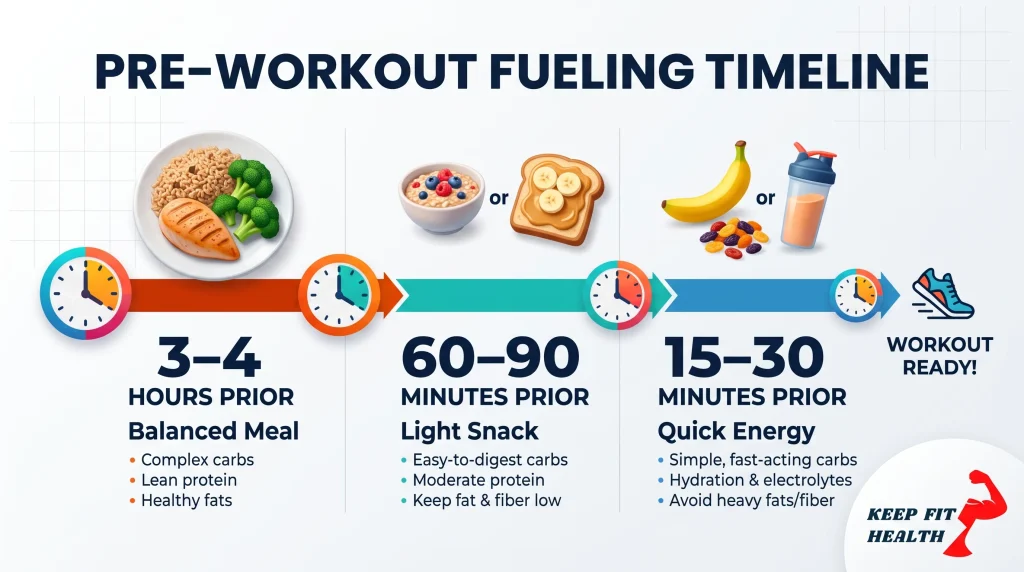
- Visual Composition: Biomechanical and nutritional timing timeline chart detailing 3-4 hour, 60-90 minute, and 15-30 minute pre-exercise windows with ideal carbohydrate-to-protein ratios.
- Image Alt Text: Pre workout nutrition timing breakdown showing carbohydrate and protein allocation windows
The Three Fueling Windows: Precision Nutrient Timing
Effective digestion requires blood flow. When you begin exercising, sympathetic nervous system activation shunts up to 80% of your cardiac output away from the splanchnic (digestive) bed and straight into working skeletal muscle. Eating the wrong foods too close to training causes gastric distress, acid reflux, and painful abdominal cramping.
Organize your fueling strategy across three distinct nutritional windows:
Window 1: The Foundation Meal (3 to 4 Hours Prior)
This is your primary baseline meal. Because your body has plenty of time to digest, absorb, and store nutrients, this meal should consist of complex, low-to-moderate glycemic index carbohydrates, lean proteins, and modest dietary fats.
- Macro Blueprint:
- Carbohydrates: 1.0 to 1.5 grams per kilogram of body mass (slow-burning sources like rolled oats, brown rice, sweet potatoes, or quinoa).
- Protein: 0.3 to 0.4 grams per kilogram of body mass (chicken breast, egg whites, tofu, or lean beef).
- Fat & Fiber: Keep fats moderate (10–15g) and avoid extreme volumes of insoluble fiber to ensure complete gastric emptying prior to training.
Window 2: The Primer Snack (60 to 90 Minutes Prior)
If you train first thing in the morning or several hours after your last meal, a primer snack bridges the gap. The goal here is simple: top off circulating blood glucose without taxing your gastrointestinal tract.
- Macro Blueprint:
- Carbohydrates: 30 to 45 grams of easily digestible, moderate-glycemic carbohydrates (ripe bananas, sourdough toast with fruit preserve, cream of rice, or plain rice cakes).
- Protein: 10 to 15 grams of rapidly absorbed protein (whey protein isolate, plant protein powder, or low-fat Greek yogurt).
- Fat & Fiber: Minimal (< 3g fat, < 2g fiber). Fat and fiber slow gastric emptying, increasing the risk of nausea during heavy sets.
Window 3: The Immediate Booster (15 to 30 Minutes Prior)
Reserved for long-duration workouts (over 75 minutes), early-morning sessions, or athletes with exceptionally high metabolic output. At this stage, digestion must be virtually instantaneous.
- Macro Blueprint:
- Carbohydrates: 15 to 25 grams of fast-acting, high-glycemic carbohydrates with very low osmolarity (dried fruit such as Medjool dates, an applesauce pouch, or an isotonic carbohydrate drink).
- Protein & Fat: Zero.
The Macro Breakdown: Carbohydrates, Protein, Fats, and Fluids
Balancing your macros for pre-workout meals requires a functional understanding of how each macronutrient behaves under physical stress.
Carbohydrates: The High-Octane Driver
Carbohydrates are the foundation of athletic performance. When evaluating whole-food options, categorize them by their digestive clearance rate:
- Complex/Low-GI (3–4 Hours Out): Steel-cut oats, wild rice, baked yams, sprouted grain bread.
- Fast/Easily Hydrolyzed (30–60 Minutes Out): Cream of rice, white jasmine rice, ripe bananas, honey, peeled potatoes.
Consuming quality pre workout nutrition for energy ensures that liver glycogen output maintains steady euglycemia (normal blood sugar levels), preventing the central nervous system from perceived burnout when training at high intensities.
Protein: Preserving Muscular Integrity
While carbohydrates provide mechanical energy, pre-workout protein delivers circulating amino acids. Research consistently demonstrates that providing essential amino acids (EAAs)—specifically leucine—prior to exercise stimulates muscle protein synthesis (MPS) and decreases muscle protein breakdown (MPB) during training.
- Focus on proteins with high biological value and rapid digestion rates.
- Whey protein isolate, egg white protein, or ultra-filtered skim milk are ideal close to workouts, whereas denser sources like turkey or salmon should be reserved for the 3-to-4-hour window.
Dietary Fats: When and Why to Limit Them
Fats are essential for long-term endocrine balance and cellular health, but they are your enemy in the immediate pre-workout window. Lipids delay gastric emptying by releasing cholecystokinin (CCK) in the duodenum.
- Consuming heavy fats (oils, butter, heavy cheese, fatty cuts of steak) within 90 minutes of training keeps food lingering in your stomach.
- As blood flow diverts to working muscles, undigested fats ferment, leading to gastrointestinal distress, bloating, and nausea.
Hydration and Intracellular Electrolytes
Hydration is an underappreciated pillar of pre-workout fueling. A mere 2% drop in total body water volume leads to an approximate 10% decline in physical work capacity, accompanied by elevated heart rates and impaired heat dissipation.
Pre-Workout Hydration Protocol:
├── 2 to 3 Hours Prior: Drink 500 to 600 ml (17 to 20 oz) of water
├── 30 Minutes Prior: Drink 250 to 350 ml (8 to 12 oz) of water
└── Critical Electrolytes: Ensure 300 to 500 mg sodium to support cellular osmotic pressure
Sodium is particularly important: it drives the sodium-glucose cotransporter (SGLT1) in the gut, accelerating both carbohydrate uptake and water absorption into your bloodstream.
Top 6 Whole-Food Fueling Meals (Categorized by Training Window)
Here are six balanced, dietitian-approved meal and snack ideas using accessible, nutrient-dense whole foods.
| Fueling Option | Target Timing | Total Carbs | Total Protein | Total Fat | Best Suited For |
| Oatmeal Bowl with Berries & Whey | 2.5 to 3 Hours | ~55g | ~25g | ~6g | Heavy leg days or long endurance sessions |
| Chicken Breast, White Rice & Zucchini | 3 to 4 Hours | ~60g | ~35g | ~5g | Afternoon training after a clean lunch |
| Sourdough Toast with Honey & Egg Whites | 60 to 90 Mins | ~38g | ~16g | ~2g | Morning lifters needing quick digestion |
| Cream of Rice with Whey Isolate | 60 to 75 Mins | ~45g | ~22g | ~1g | Sensitive stomachs needing clean glycogen |
| Ripe Bananas with a Dollop of Low-Fat Greek Yogurt | 45 to 60 Mins | ~32g | ~12g | ~1g | Fast afternoon boost before the gym |
| Medjool Dates with a Pinch of Himalayan Pink Salt | 15 to 30 Mins | ~30g | ~1g | ~0g | Immediate energy for high-intensity work |
Morning Workouts: Fasted vs. Fed Training
One of the most debated topics in fitness is whether to train in a fasted state when working out early in the morning.
Fasted vs. Fed Decision Framework:
├── Fasted Training:
│   ├── Best For: Low-intensity steady-state (LISS) cardio, recovery walks, mobility
│   └── Drawbacks: Reduced 1RM strength, blunted training volume, increased muscle catabolism
└── Fed Training:
    ├── Best For: Heavy resistance training, hypertrophy work, HIIT, sprint intervals
    └── Advantages: Enhanced high-intensity output, elevated power output, muscle preservation
The Biochemical Reality of Fasted Lifting
When you wake up after an 8-hour sleep, your liver glycogen is largely depleted (used to maintain baseline blood glucose for your brain and autonomic organs), though intramuscular glycogen remains relatively stable. If you dive straight into an intense resistance workout:
- Cortisol levels (which naturally peak in the early morning) climb higher.
- Your body increases muscle protein breakdown to convert branched-chain amino acids into usable glucose.
- Peak force output and maximal repetitions at submaximal loads suffer noticeably.
The 15-Minute Morning Solution
If you cannot stomach a solid meal at 5:30 AM, you do not need to force down a full breakfast. Instead, consume a liquid or semi-liquid carbohydrate source 15 to 20 minutes before walking into the gym. Half a glass of orange juice mixed with 5 to 10 grams of essential amino acids (EAAs) or a single ripe banana provides enough immediate circulating glucose to preserve muscle tissue and sustain high training intensity without causing stomach discomfort.
Systematic Micronutrient Integration for Energy Metabolism
Macronutrients supply raw calories, but micronutrients unlock their energy. The metabolic conversion of glucose and fatty acids into usable cellular ATP requires dozens of enzyme-driven steps that depend entirely on vitamin and mineral co-factors.
- B-Complex Vitamins (B1, B2, B3, B5, B6, B12): Act as essential coenzymes in cellular respiration, facilitating the breakdown of carbohydrates and fats through the citric acid cycle.
- Iron: Central to the structure of hemoglobin and myoglobin, ensuring adequate oxygen delivery to working skeletal muscle during demanding sets.
- Magnesium: Required for over 300 enzymatic reactions, including the structural stabilization of the ATP molecule itself.
- Zinc: Crucial for managing oxidative stress and maintaining baseline hormonal health in response to physical training.
For active individuals who struggle to hit these micronutrient requirements through whole foods alone, a clean, third-party certified dietary supplement can help prevent nutritional gaps. Review our detailed guide on the best women’s multivitamins to evaluate independently tested formulas built for active lifestyles.
4 Common Pre-Workout Nutrition Mistakes to Avoid
Avoid these frequent fueling errors that derail gym performance:
1. Eating Too Much Insoluble Fiber Right Before Training
Fiber is an essential component of gastrointestinal health, but large amounts of raw cruciferous vegetables (broccoli, cauliflower), beans, lentils, or bran cereals right before training slow down digestion. The physical mechanics of lifting weights with fermenting fiber in your digestive tract leads to gas, cramping, and sluggishness. Reserve high-fiber foods for your post-workout meal or off-hours.
2. Over-Relying on High-Dose Caffeine to Mask Poor Fueling
Stimulants are not a replacement for calories. A pre-workout drink containing 300 mg of caffeine can stimulate your central nervous system, but it provides zero actual energetic substrate. If muscle glycogen is empty, caffeine simply masks your fatigue while performance continues to drop. Pair your caffeine intake with real, digestible carbohydrates for genuine metabolic energy.
3. Ignoring Sodium and Electrolyte Balance
Drinking large amounts of plain water without accompanying electrolytes before a heavy, sweaty training session dilutes plasma sodium levels. This can trigger muscle cramps, reduce vascular pumps, and cause brain fog. Adding a pinch of sea salt (300 to 500 mg) to your pre-workout meal or hydration drink improves intracellular fluid balance and muscle contractility.
4. Introducing Unfamiliar Foods on High-Volume Days
Never experiment with new foods, high-fiber snacks, or exotic supplements right before an important training session, long race, or heavy leg day. Stick to simple, proven carbohydrate and protein sources that your digestive system tolerates without issue.
Connecting Footwear, Biomechanics, and Training Economy
Nutrition supplies the biological energy, but your body must transfer that energy efficiently into the floor. Whether you are performing loaded walking lunges, sled pushes, or power walking for conditioning, foot stability directly affects your movement economy.
Collapsing arches or improper ankle mechanics waste kinetic energy, leading to overuse issues like shin splints or heel pain that interrupt consistent training. If you deal with arch pain or excessive pronation during fitness walks or workouts, check out our clinical guides on walking with plantar fasciitis and how to select the best walking shoes for flat feet to keep your movement chain aligned and pain-free.
Frequently Asked Questions
What should I eat 30 minutes before a workout for quick energy?
Eat simple, easily absorbed carbohydrates with near-zero fat and low fiber. Two Medjool dates, an applesauce pouch, a ripe banana, or two plain white rice cakes with a drizzle of honey provide rapidly digestible glucose that reaches your bloodstream quickly without causing stomach upset.
Can I just take a pre-workout powder instead of eating food?
Pre-workout powders primarily deliver stimulants (such as caffeine), vasodilators (like L-citrulline), and buffering agents (such as beta-alanine). They contain virtually no calories or glycogen-restoring carbohydrates. While they can increase mental alertness, they do not replace dietary energy. For optimal performance, pair your supplement with genuine whole-food carbohydrates.
What should I do if I feel nauseous when working out after eating?
Nausea typically indicates that your meal was too large, contained too much dietary fat or fiber, or was consumed too close to the start of your workout. Shift your primary meal to 3 to 4 hours prior to exercise, or switch to easily digestible, low-fat liquid carbohydrates (such as fruit smoothies or cream of rice) in the 60-minute window.
Does pre-workout protein intake actually improve performance?
Yes. Consuming 15 to 25 grams of lean, rapidly absorbed protein prior to training elevates blood levels of essential amino acids. This shifts your net protein balance, attenuating exercise-induced muscle protein breakdown and kickstarting the recovery and muscle-building process before your workout even ends.
Final Thoughts & Daily Action Steps
Structuring your pre workout nutrition for energy does not require complicated meal plans or expensive sports supplements. By strategically allocating your meals—enjoying balanced, complex carbohydrates and lean proteins several hours before training, followed by a light, easily digestible carbohydrate snack as your session approaches—you provide your body with the fuel it needs for sustained muscular power.
Combine consistent, high-quality fueling with deliberate hydration and sound movement mechanics. With your nutritional foundations in place, your workouts will feel lighter, your recovery will speed up, and your progress will compound over time.
For more evidence-based fitness advice, nutritional breakdowns, and mobility guides, explore our resources across Keep Fit Health, and connect directly with Dorene Lambert on Facebook to keep your wellness journey on track.