
Last Updated on November 3, 2026 by Dorene Lambert
Editorial & Exercise Safety Note: The resistance training programs, kinetic cues, and volume prescriptions provided in this guide are intended strictly for educational and instructional purposes. Before beginning any new vigorous weight training regimen, consult a licensed physician or physical therapist, especially if you have a history of shoulder impingement, lower lumbar disc injuries, or cardiovascular conditions.
Starting a structured dumbbell workout for beginners is one of the most practical and scientifically proven strategies to build lean muscle, increase bone mineral density, and burn visceral fat from home. While commercial fitness culture often suggests you need complicated multi-station cable machines or Olympic barbell platforms to make serious physical progress, free weights like dumbbells offer superior biomechanical freedom. They accommodate individual joint angles, expose side-to-side muscular imbalances, and safely introduce your central nervous system to multi-planar resistance training.
Free weight training is not about lifting until you drop; it is about building motor unit recruitment and mastering movement patterns. By emphasizing mechanical tension, respecting recovery timelines, and executing fundamental human movement patterns—the squat, hinge, push, pull, and carry—a well-designed dumbbell workout for beginners transforms random home lifting into an evidence-based muscle-building engine.
Why Dumbbells Outperform Barbells and Machines for New Lifters
When entering resistance training, beginners often struggle with the rigid bar paths imposed by fixed machines and heavy barbells. Dumbbells provide distinct kinetic advantages:
Dumbbell Training Kinetic Advantages:
├── 1. Independent Limb Loading: Prevents the dominant arm/leg from masking contralateral weakness
├── 2. Joint-Friendly Freedom: Allows natural wrist, elbow, and shoulder rotation across the repetition
├── 3. Core Stabilization: Increases recruitment of obliques, transverse abdominis, and multifidus
└── 4. Safety & Fail-Safe Mechanics: Dumbbells can be safely released to the floor without getting trapped
1. Eliminating Bilateral Muscular Deficits
Most people have a dominant side. When performing a standard barbell bench press or barbell squat, the stronger side quietly absorbs up to 15% more load than the weaker side. Over months of training, this creates noticeable asymmetrical strength gaps that can lead to joint torque and overuse injuries. Because dumbbells require each limb to move its own load independently, your weaker side is forced to build equal motor control and force output.
2. Natural Multi-Planar Joint Trajectories
Barbells lock your hands and wrists into a fixed horizontal plane. For individuals with limited shoulder internal rotation or subtle wrist stiffness, pressing a straight bar can cause anterior shoulder impingement or wrist strain. Dumbbells allow your hands to move naturally from a pronated position into a neutral or semi-supinated grip, matching your unique skeletal anatomy and protecting joint capsules.
The 5 Foundational Movement Patterns Every Beginner Must Master
Rather than thinking about training individual muscle heads in isolation (like doing endless sets of bicep curls), an effective routine centers on human movement patterns. Mastering these five movements ensures complete, balanced physical development.
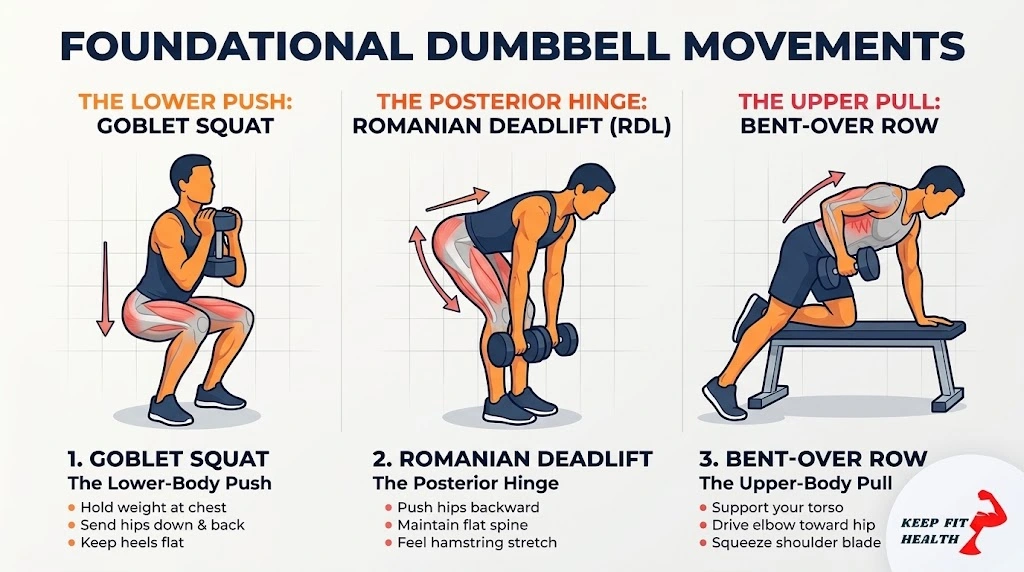
1. The Lower-Body Push: The Dumbbell Goblet Squat
The goblet squat is the premier squatting variation for beginners. Holding a single dumbbell vertically against your sternum acts as an anterior counterbalance, allowing your torso to remain upright while keeping your hips centered between your heels.
- Primary Muscles Recruited: Quadriceps, gluteus maximus, adductor magnus, anterior core.
- Biomechanical Setup:
- Stand tall with your feet shoulder-width apart, toes flared slightly outward (15 to 30 degrees).
- Cup the top end of a dumbbell with both hands against your chest, keeping your elbows tucked downward like a goblet.
- Inhale into your belly, brace your core, and initiate the descent by breaking simultaneously at your hips and knees.
- Squat down until your hip crease drops parallel with or slightly below the tops of your kneecaps, keeping your heels firmly planted.
- Drive the floor away through your midfoot and squeeze your glutes to return to a standing position.
2. The Posterior Hinge: The Dumbbell Romanian Deadlift (RDL)
Unlike a squat where your knees bend deeply, the hinge is driven almost entirely by sending your hips backward while maintaining a soft, fixed knee angle. This targets the posterior kinetic chain, directly supporting lower back resilience.
- Primary Muscles Recruited: Hamstrings, gluteus maximus, erector spinae, latissimus dorsi.
- Biomechanical Setup:
- Stand with feet hip-width apart, holding a pair of dumbbells against the fronts of your thighs with a neutral overhand grip.
- Soften your knees slightly (roughly 15 to 20 degrees of bend) and lock that knee angle in place.
- Push your hips backward toward an imaginary wall behind you while sliding the dumbbells down the fronts of your shins.
- Lower the weights only until you feel a deep stretch in your hamstrings (usually right around mid-shin level). Do not round your lower back to reach lower.
- Squeeze your glutes and push your hips forward to stand tall.
3. The Upper-Body Horizontal Pull: Single-Arm Dumbbell Row
Developing a strong upper back balances the postural strain caused by daily sitting, computer work, and driving. Supporting one knee and hand on a sturdy bench or chair removes lumbar shear stress, letting you isolate the latissimus dorsi and rhomboids.
- Primary Muscles Recruited: Latissimus dorsi, rhomboids, rear deltoids, middle trapezius, biceps brachii.
- Biomechanical Setup:
- Place your left knee and left hand firmly on a flat bench or stable chair, keeping your torso parallel to the floor.
- Hold a dumbbell in your right hand, letting the arm hang straight down beneath your shoulder.
- Initiate the pull by driving your right elbow back toward your hip pocket, rather than pulling the weight up toward your chest.
- Squeeze your back muscles at the top of the repetition for a full second without rotating your shoulders or twisting your torso.
- Lower the weight under control over a 2-second count.
4. The Upper-Body Horizontal Push: Dumbbell Floor Press / Bench Press
If you do not have a flat workout bench at home, the floor press is an effective, shoulder-safe alternative. The floor acts as a natural depth stop, preventing your elbows from hyperextending past your ribcage and taking excessive strain off the anterior shoulder capsule.
- Primary Muscles Recruited: Pectoralis major, anterior deltoids, triceps brachii.
- Biomechanical Setup:
- Lie flat on your back on an exercise mat with your knees bent and feet flat on the floor.
- Hold a dumbbell in each hand with your upper arms resting on the floor at a 45-degree angle to your torso (avoid flaring your elbows straight out at 90 degrees).
- Exhale and press the dumbbells upward until your arms are fully extended over your chest.
- Lower the dumbbells slowly until your triceps gently touch the floor, pause for a moment to eliminate momentum, and press again.
5. The Overhead Vertical Press: Seated Dumbbell Shoulder Press
Pressing overhead from a seated position eliminates leg drive, ensuring your deltoids and triceps perform the work while providing back support.
- Primary Muscles Recruited: Anterior and lateral deltoids, clavicular pectoralis, triceps, upper trapezius.
- Biomechanical Setup:
- Sit on a chair or bench with your feet flat on the floor and your spine upright and neutral.
- Bring the dumbbells up to shoulder height with a semi-neutral grip (palms facing roughly 45 degrees inward toward each other).
- Press the dumbbells straight upward in a slight arc until your elbows lock out overhead.
- Lower the weights back to the tops of your shoulders over a controlled 2-second tempo.
The Complete 3-Day Full-Body Dumbbell Routine for Beginners
When starting out, a full-body split performed three non-consecutive days per week (e.g., Monday, Wednesday, Friday) works best. It provides frequent stimulus to all major muscle groups while allowing 48 hours of recovery between sessions for tissue remodeling and glycogen resynthesis.
Weekly Training Split Schedule:
├── Monday: Full-Body Workout A
├── Tuesday: Active Recovery / Low-Impact Walking
├── Wednesday: Full-Body Workout B
├── Thursday: Active Recovery / Mobility Focus
├── Friday: Full-Body Workout A
└── Weekend: Rest & Systematic Recovery
*(The following week, alternate: Week 2 runs B-A-B)*
Workout A (Full-Body Strength Focus)
| Exercise Order | Exercise Name | Target Muscle Groups | Sets | Repetitions | Rest Interval |
| 1 | Dumbbell Goblet Squat | Quadriceps, Glutes, Core | 3 | 8 – 10 | 90 seconds |
| 2 | Dumbbell Floor Press | Chest, Triceps, Shoulders | 3 | 8 – 10 | 90 seconds |
| 3 | Single-Arm Dumbbell Row | Lats, Upper Back, Biceps | 3 | 10 – 12 per side | 60 seconds |
| 4 | Dumbbell Romanian Deadlift | Hamstrings, Posterior Chain | 3 | 10 – 12 | 90 seconds |
| 5 | Standing Dumbbell Bicep Curl | Biceps Brachii | 2 | 12 – 15 | 60 seconds |
| 6 | Lying Dumbbell Tricep Extension | Triceps (Long Head) | 2 | 12 – 15 | 60 seconds |
Workout B (Hypertrophy & Postural Balance Focus)
| Exercise Order | Exercise Name | Target Muscle Groups | Sets | Repetitions | Rest Interval |
| 1 | Dumbbell Static Split Squat | Glutes, Quads, Hamstrings | 3 | 8 – 10 per leg | 90 seconds |
| 2 | Seated Dumbbell Shoulder Press | Deltoids, Upper Traps | 3 | 8 – 10 | 90 seconds |
| 3 | Two-Arm Dumbbell Chest-Supported Row | Mid-Back, Rhomboids, Lats | 3 | 10 – 12 | 75 seconds |
| 4 | Dumbbell Glute Bridge (from floor) | Gluteus Maximus, Core | 3 | 12 – 15 | 60 seconds |
| 5 | Dumbbell Lateral Raises | Lateral Deltoids | 3 | 12 – 15 | 60 seconds |
| 6 | Standing Dumbbell Farmer’s Walk | Grip Strength, Core, Traps | 3 | 40 steps | 60 seconds |
How to Apply Progressive Overload Without Hurting Yourself
Progressive overload is the foundation of resistance training. To build muscle and strength, you must systematically increase the mechanical work your muscular tissues perform over time. However, beginners often make the mistake of adding heavy weight before their movement mechanics are fully solid.
The Safe Progression Hierarchy for Beginners:
1. Movement Competence: Complete all sets with strict, repeatable form
2. Repetition Range: Progress from the bottom of the rep range to the top (e.g., from 8 reps to 12 reps)
3. Set Volume: Add a set once recovery allows (moving from 2 sets to 3 sets)
4. Load (Weight): Increase dumbbell weight by 2.5 to 5 lbs once you hit the top rep target
The Double-Progression Method Explained
The safest way to apply progressive overload during a dumbbell workout for beginners is the double-progression method.
- Choose a weight you can handle for 3 sets of 8 reps with good form.
- Keep that same weight until you can perform all 3 sets for 12 clean reps.
- Once you hit 3 sets of 12 reps, increase the weight by the smallest available increment (usually 2.5 to 5 lbs per dumbbell).
- With the heavier weight, your reps will naturally drop back down to around 8 reps per set.
- Repeat the process. This method ensures your joints, ligaments, and tendons adapt steadily without sudden spikes in injury risk.
Choosing Your First Dumbbell Set: Fixed Hex vs. Adjustable
Selecting the right equipment for a home gym comes down to your budget, available floor space, and training goals.
Dumbbell Equipment Selection:
├── Rubber Hex Dumbbells:
│   ├── Pros: Virtually indestructible, non-rolling design, fast to grab between sets
│   └── Cons: Requires dedicated rack space; buying multiple pairs gets expensive over time
└── Dial/Pin Adjustable Dumbbells:
    ├── Pros: Replaces 15 pairs of dumbbells in the footprint of two shoes; cost-effective
    └── Cons: Larger casing can feel bulky on tight movements; sensitive internal gears if dropped
- Where to Start with Weight:
- Most women new to lifting do well starting with a pair of 5 lb, 10 lb, and 15 lb dumbbells.
- Most men new to lifting do well starting with a pair of 10 lb, 15 lb, and 25 lb dumbbells.
- If purchasing adjustable dumbbells, look for sets that scale from 5 lbs up to 50 lbs, which can comfortably support your first two years of progressive overload.
Nutritional Foundations to Fuel Strength and Muscle Repair
Lifting weights provides the mechanical stimulus for adaptation, but muscle tissue is rebuilt during recovery through dietary amino acids, adequate calories, and proper micronutrient balance.
1. Daily Protein Requirements
To support muscle protein synthesis (MPS) and repair micro-damage created during resistance training, aim for 0.7 to 1.0 grams of dietary protein per pound of body weight (1.6 to 2.2 grams per kilogram) daily. High-quality whole-food sources include skinless chicken breast, lean ground beef, wild salmon, whole eggs, tofu, tempeh, and whey protein isolate.
2. Pre- and Post-Workout Fueling
Never lift weights while completely depleted of liver and muscular glycogen. Consuming easily digestible carbohydrates paired with a moderate protein source 60 to 90 minutes before lifting ensures steady blood glucose and elevated muscular endurance. For an in-depth breakdown of carbohydrate-to-protein timing windows and meal options, read our guide on pre workout nutrition for energy.
3. Micronutrients for Connective Tissue and Muscle Function
Resistance training increases the turnover of several key minerals and co-factors, including magnesium (for muscular contraction and relaxation), zinc (for protein synthesis), and vitamin D3 (for muscular power output and bone density). Active individuals who want to cover nutritional bases with third-party tested formulas can review our analysis on the best women’s multivitamins.
4 Common Beginner Mistakes to Avoid
Avoid these frequent errors to keep your workouts safe, consistent, and productive:
1. Lifting with Momentum and Inadequate Eccentric Control
Swinging the dumbbells using body english takes mechanical tension off the target muscle and transfers it into connective joints. Always lower the weight under control over a 2-to-3-second eccentric phase. The muscle damage that stimulates growth occurs largely during this controlled lowering portion of the lift.
2. Skipping the Warm-Up
Lifting weights with cold muscles and stiff joint capsules increases the risk of muscle strains. Spend 5 to 7 minutes before your workout doing dynamic movements: arm circles, cat-cows, bodyweight squats, and hip openers.
3. Wearing Soft, Unstable Running Shoes While Lifting
Thick, squishy running shoes with soft foam cushions are designed to absorb impact while moving forward—not provide a firm base for lifting weights. When squatting or pressing with dumbbells, soft soles compress unevenly, causing your ankles and knees to wobble. Lift in flat-soled shoes (like Converse or minimalist trainers) or simply in your socks on a clean home gym mat. If you deal with fallen arches, explore our guide on the best walking shoes for flat feet to understand how stable footwear protects the lower kinetic chain.
4. Training to Absolute Muscular Failure on Every Set
Taking every set until the dumbbell literally falls out of your hands generates excessive central nervous system fatigue without added hypertrophy benefit. As a beginner, end most work sets with 1 to 2 reps in reserve (RIR)—the point where you could perform another rep with good form if forced to, but choose to rack the weight.
Frequently Asked Questions
How heavy should my dumbbells be when starting out?
Select a weight that allows you to complete all target repetitions with good form, while feeling challenging during the final 2 to 3 reps. If your form breaks down, you swing your torso, or your joints ache, the dumbbell is too heavy. If you easily breeze through all sets without needing a rest, you can safely increase the load.
Can I build real muscle using only dumbbells at home?
Yes. Your muscle fibers do not know the difference between a high-end commercial gym machine and a simple pair of dumbbells. Muscle hypertrophy responds to mechanical tension, progressive overload, and adequate nutrition. As long as you train within 1 to 3 repetitions of muscular failure and progressively increase your reps or weight over time, dumbbells can build substantial muscle mass and functional strength.
Should I do cardio on the same days as my dumbbell workouts?
If your primary goal is building strength and muscle, perform your dumbbell workout first when your energy and nervous system are fresh, or schedule your cardio sessions on alternate recovery days. Low-impact cardiovascular exercise, like walking for lower back pain or steady-state trail walking, pairs exceptionally well with resistance training without blunting your muscular adaptations.
How long does a full-body dumbbell workout take?
A beginner full-body workout consisting of 5 to 6 exercises, performed for 3 sets each with 60 to 90 seconds of rest, typically takes 40 to 50 minutes, including a thorough dynamic warm-up.
Final Thoughts & Daily Action Plan
Building consistent strength from home does not require complicated routines or crowded gym floors. By focusing on fundamental multi-joint movements, tracking your volume, and applying progressive overload with good form, a basic dumbbell workout for beginners gives you a complete, sustainable blueprint for long-term health and functional fitness.
Commit to three sessions per week, pair your training with whole-food nutrition, and prioritize your recovery between workouts.
For more evidence-based strength guides, joint recovery protocols, and nutrition breakdowns, explore our complete library across Keep Fit Health, and connect directly with Dorene Lambert on Facebook for weekly form tutorials and coaching advice.