
Last Updated on October 30, 2026 by Dorene Lambert
Affiliate & Medical Disclaimer: This article contains affiliate links. If you purchase through these links, Keep Fit Health may earn an affiliate commission at no extra cost to you. The ergonomic analyses and exercise suggestions provided here are for educational purposes and do not substitute for personalized clinical diagnosis or medical care from a licensed orthopedic physician.
Taking a brisk morning stroll should clear your head and strengthen your cardiovascular system—not trigger a searing, burning sensation up the back of your heel. If every foot strike feels like a taught rubber band pulling at your calcaneus, you are likely battling Achilles tendinopathy.
The Achilles tendon is the thickest and strongest tendon in the human body, connecting your gastrocnemius and soleus calf muscles to your heel bone. It withstands forces up to 10 times your body weight during explosive movement. However, when repetitive stress outpaces cellular repair, micro-tears and localized inflammation turn simple daily walking into an ordeal.
The right pair of walking shoes does not simply pad your step—it fundamentally alters ankle kinematics. By offloading mechanical strain from the tendon through optimized heel-to-toe drops, firm heel counters, and rockered geometries, you can stop aggravating the injury and start active recovery.
Below is an exhaustive, podiatrist-backed breakdown of the top footwear options for Achilles tendonitis in 2026, alongside biomechanical guidance to help you regain pain-free movement.
Quick Comparison: Top Walking Shoes for Achilles Tendon Relief
| Shoe Model | Best For | Heel-to-Toe Drop | Cushioning Type | Key Feature | Amazon Link |
| Brooks Ghost 16 | Overall Daily Walking | 12 mm | DNA LOFT v3 Nitrogen-Infused | High heel drop removes tendon tension | Check Price on Amazon |
| Hoka Bondi 8 | Maximum Shock Absorption | 4 mm (Active Rocker) | Ultra-Plush EVA Foam | Early-stage Meta-Rocker limits flexion | Check Price on Amazon |
| ASICS Gel-Kayano 31 | Overpronation & Flat Feet | 10 mm | FF BLAST PLUS ECO & PureGEL | 4D Guidance System stabilizes ankle roll | Check Price on Amazon |
| New Balance Fresh Foam X More v4 | Wide Feet & Plantar Comfort | 4 mm (Rocker) | Fresh Foam X Cushioning | Wide stable base & generous toe box | Check Price on Amazon |
| Saucony Triumph 22 | Long-Distance Walkers | 10 mm | PWRRUN PB Superfoam | High energy return and molded heel collar | Check Price on Amazon |
The Biomechanics of Achilles Tendonitis: Why Regular Shoes Fail
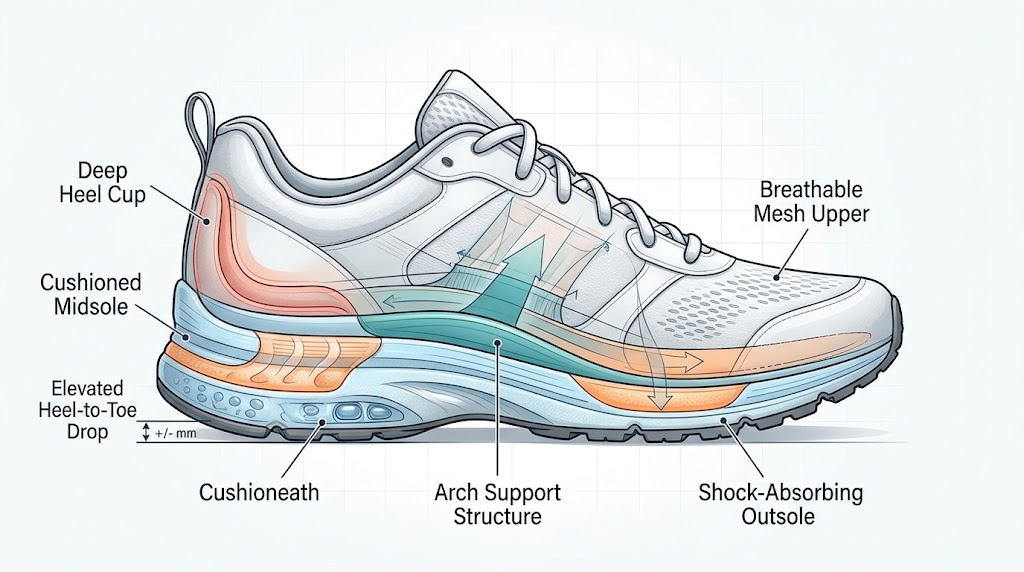
When treating insertional or mid-portion Achilles tendinopathy, generic sneakers or barefoot-style minimalist footwear often compound the problem. Understanding the underlying foot mechanics clarifies why tailored shoe construction is vital.
1. The Critical Role of Heel-to-Toe Drop
The “heel-to-toe drop” refers to the height differential between the shoe’s heel stack and forefoot stack.
- Low-drop shoes (0 mm to 4 mm): Force the foot into prolonged dorsiflexion, lengthening the calf complex and stretching the Achilles tendon taut across the back of the ankle with every stride.
- High-drop shoes (10 mm to 12 mm): Place the ankle in a slight, continuous state of plantarflexion. This small elevation shortens the muscle-tendon unit, decreasing peak tensile stress during heel strike and late midstance.
2. Excessive Pronation and the “Whiplash” Effect
Overpronation is common among individuals who also need specialized footwear, such as individuals browsing our best walking shoes for flat feet guide. When your foot arches collapse inward, the calcaneus tilts sideways. This creates an asymmetrical rotational torque—frequently referred to as an “Achilles tendon whip”—shearing the collagen fibrils unevenly and delaying tissue healing.
3. Impact Shock Dispersion
Every heel strike sends a shockwave up the kinetic chain. If a shoe has a compacted, dead midsole, that percussive load travels straight into the tendon attachment. Modern performance foams act as mechanical shock absorbers, dampening the peak ground reaction forces before they reach the lower leg.
Detailed In-Depth Reviews: 5 Best Walking Shoes for Achilles Tendonitis
1. Brooks Ghost 16 — Best Overall Walking Shoe for Achilles Pain Relief
If there is one shoe that physical therapists and podiatrists consistently recommend for lower-leg tendinopathy, it is the Brooks Ghost series.
The Brooks Ghost 16 features a traditional 12 mm heel-to-toe drop, the sweet spot for taking immediate tension off a strained Achilles. The midsole has been upgraded with nitrogen-infused DNA LOFT v3 foam, delivering balanced cushioning that avoids feeling overly mushy or unstable.
Key Specs:
- Heel-to-Toe Drop: 12 mm
- Midsole Material: Nitrogen-infused DNA LOFT v3
- Weight: ~9.5 oz (Men) / 8.5 oz (Women)
- Pronation Profile: Neutral
Why it relieves Achilles pain: The steep 12 mm drop ensures that your ankle does not drop into deep dorsiflexion when your heel hits the ground. Additionally, Brooks implements a rigid external heel counter that locks your calcaneus firmly in place, preventing micro-shifts that aggravate the tendon sheath. The padded heel collar features an ergonomic notch that avoids rubbing directly against the inflamed tendon.
- Pros:
- Industry-leading 12 mm drop relieves tension on the calf-Achilles complex.
- Reinforced, structured heel cup stabilizes rearfoot strike.
- Plush Achilles collar prevents friction on sensitive skin.
- Cons:
- Not engineered for severe overpronators needing rigid medial arch posts.
- Firmer ride compared to max-cushion platform shoes.
🛒 Check Current Availability: View the Brooks Ghost 16 on Amazon
2. Hoka Bondi 8 — Best Max-Cushioning with Smooth Rocker Geometry
While the Hoka Bondi 8 has a lower nominal drop (4 mm), it addresses Achilles strain through a completely different biomechanical approach: Early-Stage Meta-Rocker Technology.
Rather than relying purely on heel elevation, the Bondi 8 functions like a wheel. Its curved, rockered sole rolls your foot forward from heel strike to toe-off without requiring excessive flexing at the metatarsophalangeal joints or aggressive ankle movement.
Key Specs:
- Heel-to-Toe Drop: 4 mm
- Midsole Material: Compression-molded EVA (CMEVA)
- Stack Height: 39 mm heel / 35 mm forefoot
- Sole Geometry: Extended rear crash pad with rocker profile
Why it relieves Achilles pain: If your Achilles pain is accompanied by arthritis or plantar fascia inflammation, the massive stack of compression-molded EVA absorbs virtually all ground feedback. The stiff rocker prevents your foot from bending sharply at terminal stance, sparing the tendon from explosive concentric contractions.
- Pros:
- Extreme shock mitigation protects the lower extremities from repetitive impact.
- Rocker sole reduces required ankle flexion during push-off.
- Broad base platform prevents lateral wobbling despite high stack heights.
- Cons:
- Low 4 mm static drop might require a brief adjustment period for short calf muscles.
- Bulky aesthetic may feel heavy for casual, fast-paced walking.
🛒 Check Current Availability: View the Hoka Bondi 8 on Amazon
3. ASICS Gel-Kayano 31 — Best Stability Shoe for Flat Feet & Overpronation
If your Achilles tendonitis is driven by inward ankle roll and fallen arches, a neutral shoe like the Ghost will not solve your root dysfunction. The ASICS Gel-Kayano 31 is designed to address this problem.
Equipped with a 10 mm heel drop and ASICS’ revolutionary 4D Guidance System, the Kayano adapts to your stride dynamically. Instead of jamming a hard plastic wedge under your arch, it uses softer, resilient medial foam that cushions the foot and restores optimal alignment only when your gait begins to deviate.
Key Specs:
- Heel-to-Toe Drop: 10 mm
- Midsole: FF BLAST PLUS ECO with PureGEL rearfoot capsule
- Stability System: Dynamic 4D Guidance System
- Weight: ~10.7 oz (Men) / 9.3 oz (Women)
Why it relieves Achilles pain: The combination of a supportive 10 mm heel elevation and dynamic pronation control halts the destructive twisting vector on the tendon. The updated PureGEL insert in the heel provides 65% softer landings than standard gel configurations, shielding the calcaneal insertion zone.
- Pros:
- 10 mm drop reduces calf load while stabilizing pronation.
- 4D Guidance System prevents medial ankle collapse and rotational tendon strain.
- Highly breathable engineered mesh upper keeps feet cool on long routes.
- Cons:
- Moderately heavier than stripped-down neutral walkers.
- Premium price point.
🛒 Check Current Availability: View the ASICS Gel-Kayano 31 on Amazon
4. New Balance Fresh Foam X More v4 — Best for Wide Feet & Forefoot Relief
Individuals with wide feet frequently suffer when tight shoes compress their metatarsals, throwing off their entire gait cycle and overworking the posterior tibial and Achilles tendons. The New Balance Fresh Foam X More v4 provides a wide, accommodating fit with exceptional cloud-like cushioning.
Key Specs:
- Heel-to-Toe Drop: 4 mm
- Midsole Material: Fresh Foam X Dual-Density
- Width Options: Standard (D), Wide (2E), Extra Wide (4E)
- Outsole: Targeted rubber placement with flex zones
Why it relieves Achilles pain: With one of the widest anatomical footprints in the walking category, this model distributes ground pressure evenly. A distinct rocker sole accelerates transitions, and the heel bevel cushions calcaneal strike. The heel counter is deeply padded with ultra-soft memory foam, eliminating pressure on sensitive Haglund’s deformities (“pump bumps”) often found at the Achilles insertion.
- Pros:
- Generous toe box and wide widths (up to 4E) prevent lateral pinching.
- Pillow-soft Fresh Foam X protects joints from pavement shock.
- Padded Achilles pocket eliminates friction and heel slippage.
- Cons:
- Lower 4 mm drop means calf stretching must be managed carefully.
- High midsole volume can feel buoyant for users accustomed to traditional firm soles.
🛒 Check Current Availability: View the New Balance Fresh Foam X More v4 on Amazon
5. Saucony Triumph 22 — Best Responsive Ride for High-Mileage Fitness Walkers
For fitness walkers who maintain a fast 15-minute-per-mile pace, overly soft midsoles can cause foot fatigue by absorbing too much energy. The Saucony Triumph 22 introduces PWRRUN PB superfoam—the same beaded PEBA material used in marathon racing shoes—to everyday walking.
Key Specs:
- Heel-to-Toe Drop: 10 mm
- Midsole Material: 100% PWRRUN PB (Polyether block amide)
- Heel Stack: 37 mm
- Weight: ~10.1 oz (Men) / 8.8 oz (Women)
Why it relieves Achilles pain: The 10 mm drop provides the elevation your Achilles needs, while the responsive PEBA midsole actively springs back with each stride. This mechanical rebound reduces the muscular effort required by your calves to propel you forward, preserving tendon reserves during long fitness walks.
- Pros:
- Energetic, bouncy rebound reduces muscular fatigue in the lower leg.
- 10 mm drop elevates the heel to a safe resting angle.
- Durable carbon rubber outsole lasts hundreds of road miles.
- Cons:
- Snug midfoot wrap may feel tight for individuals with high insteps.
- Premium pricing reflective of PEBA superfoam construction.
🛒 Check Current Availability: View the Saucony Triumph 22 on Amazon
Essential Buyer’s Checklist: What to Look for in Achilles-Friendly Shoes
Before purchasing your next pair of walking shoes, check them against these four core biomechanical benchmarks:
- Heel-to-Toe Drop of 8 mm to 12 mm (or Rocker Sole): Avoid zero-drop minimalist shoes during an active flare-up. Keep the heel elevated to reduce the pulling force on your lower leg.
- Firm, Supportive Heel Counter: Squeeze the back collar of the shoe. If it folds flat easily under your thumb, it lacks the structure needed to prevent ankle wobbling. Look for shoes with a molded internal plastic cup.
- Achilles Notch and Cushioning: Ensure the back edge of the collar does not curve aggressively inward toward the tendon. A curved notch or pillow-soft collar reduces direct chafing against inflamed tissue.
- Torsional Rigidity: Grasp the shoe at the toe and heel, then twist it like a wet towel. A quality shoe should resist excessive twisting along the midfoot shank to protect the arch and tendon line.
4-Step Active Rehabilitation Protocol: Beyond Just the Shoes
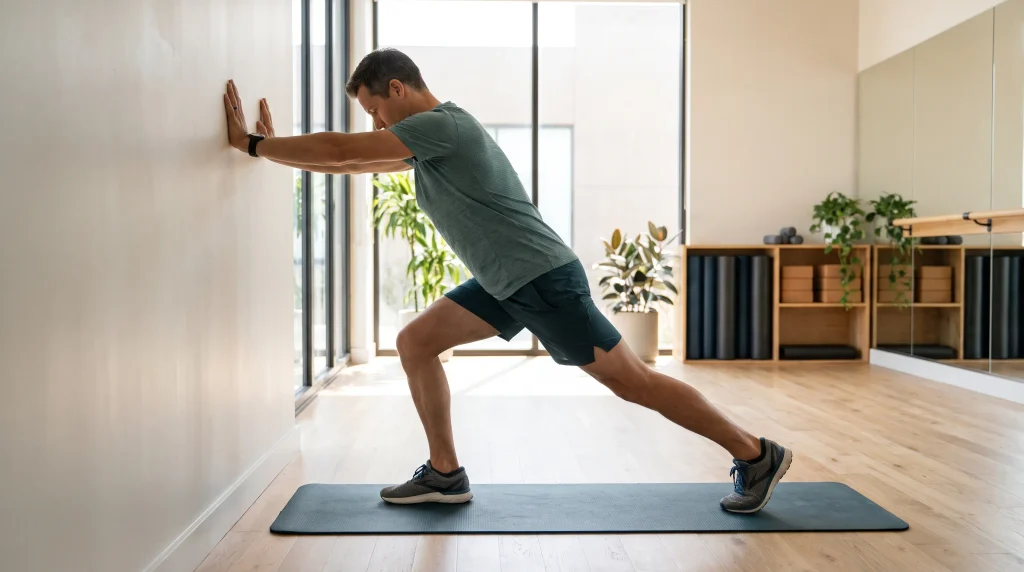
Pairing supportive footwear with daily movement habits accelerates tissue remodeling. Passive rest alone rarely cures chronic tendinopathy—tendons require structured, progressive mechanical loading to align collagen fibers.
1. Progressive Eccentric Loading (The Alfredson Protocol)
Eccentric heel drops remain the gold standard clinical exercise for mid-portion Achilles tendinitis:
- Stand on the balls of both feet on the edge of a step.
- Rise up onto both toes.
- Transfer your body weight onto the injured leg.
- Slowly lower your heel below the step level over a controlled 3-to-4-second count.
- Use the uninjured leg to push yourself back to the starting position.
- Aim for 3 sets of 15 repetitions daily.
2. Targeted Myofascial Foam Rolling
Never roll directly over the inflamed Achilles tendon or the back of the heel bone. Instead, foam roll the upper and mid-belly of the gastrocnemius and soleus muscles. Releasing tightness in the calf muscle bellies decreases the passive tension pulling on the distal tendon.
3. Adjust Stride Cadence
Overstriding—reaching your foot too far in front of your center of mass—amplifies the braking forces sent up through your heel. Shorten your walking stride slightly and increase your step cadence. Landing with your foot directly beneath your hips minimizes impact peaks and reduces tendon stress.
4. Systemic Nutritional Support for Connective Tissue
Tendon remodeling requires specific micronutrients to rebuild structural collagen. Ensure your daily nutrition includes:
- Vitamin C & Zinc: Critical enzymatic co-factors for collagen cross-linking and fibroblast activation.
- Hydrolyzed Collagen Peptides: Supplementing with 10–15g of collagen 45 minutes prior to rehab loading enhances amino acid delivery to connective tissues.
- Balanced Micronutrient Profile: If your daily diet has nutritional gaps, a high-purity formula can help maintain metabolic baselines. Read our comprehensive analysis on the best women’s multivitamin options to learn how to choose third-party verified, bioavailable nutrient formulas.
Frequently Asked Questions (FAQ)
Can I use zero-drop or barefoot shoes if I have Achilles tendonitis?
No. Barefoot and zero-drop footwear should be avoided during an acute or subacute Achilles flare-up. Because zero-drop platforms have zero heel elevation, they stretch the Achilles tendon to its maximum length with every step, substantially increasing tensile load. While minimalist shoes can be used during later maintenance phases to build foot strength, recovery requires an elevated drop (8 mm to 12 mm) to unload stressed tissue.
How do I know if I have insertional vs. mid-portion Achilles tendonitis?
- Mid-portion tendinopathy: Pain and swelling occur 2 to 6 centimeters above the heel bone in the narrow waist of the tendon. This type responds well to eccentric heel drops performed off the edge of a step.
- Insertional tendinopathy: Pain occurs right where the tendon anchors into the posterior calcaneus (heel bone). For insertional issues, perform heel drops on flat ground only; dropping below step level causes the tendon to compress painfully against the bone.
Are custom orthotics better than shoe cushioning for tendonitis?
Custom orthotics are effective if your tendonitis is caused by structural overpronation or limb length discrepancies. However, for many walkers, a high-quality stability shoe with a built-in 10 mm drop provides sufficient rearfoot control. If pain persists beyond 6 weeks of wearing supportive footwear, consult a podiatrist for custom gait scanning.
When should I replace my walking shoes?
Replace walking shoes every 350 to 500 miles, or roughly every 6 months of daily use. While the outsole rubber may still appear intact, internal EVA and superfoam midsoles lose their elasticity and shock-absorbing capacity over time, transferring impact loads back into your Achilles tendon.
Final Thoughts & Next Steps
Living with Achilles tendon pain does not mean you have to give up your daily walks and active lifestyle. By switching to a shoe with an elevated heel drop (such as the Brooks Ghost 16) or smooth rocker mechanics (like the Hoka Bondi 8), you immediately reduce the repetitive microtrauma that keeps your lower leg inflamed.
Combine the right pair of shoes with daily eccentric loading, gentle calf mobility, and proper rest. Your tendon will gradually rebuild its load tolerance, allowing you to walk comfortably again.
For more hands-on footwear breakdowns and exercise programming tailored to common foot conditions, explore our companion guide on the best walking shoes for flat feet and connect with Dorene Lambert on Facebook for weekly recovery and mobility tips.